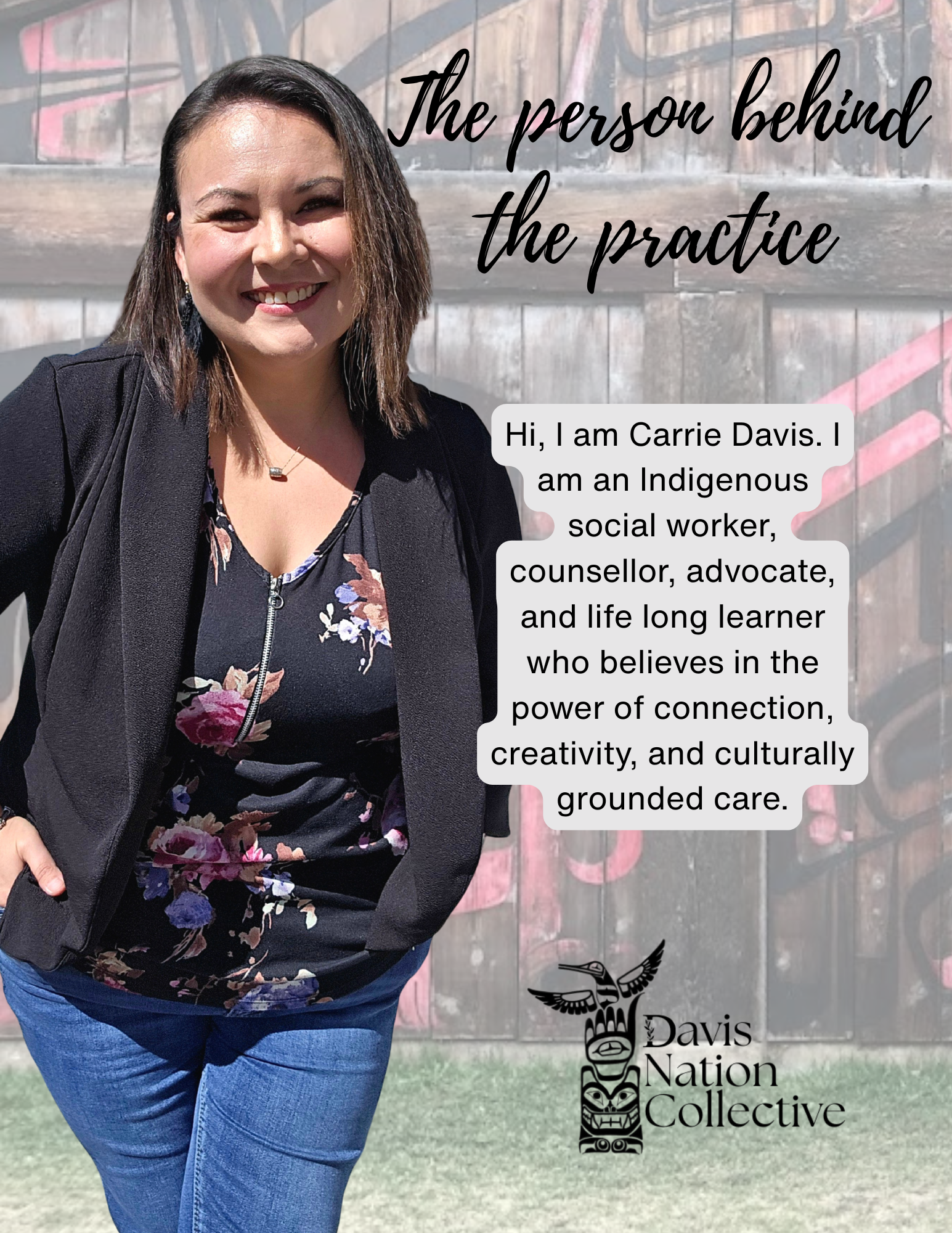
My name is Carrie Davis. I am a proud member of the Gitxsan Nation, belonging to the Laxgibuu clan of Anspayaxw, BC. My roots trace back to Prince Rupert and Terrace though I’ve called Prince George home for the past 15 years. I hold a Masters Degree in Social Work and am Registered with the BC College of Social Work. Davis Nation Collective is where I blend many talents including Indigenous Social Work, Indigenous art, and various forms of creativity.
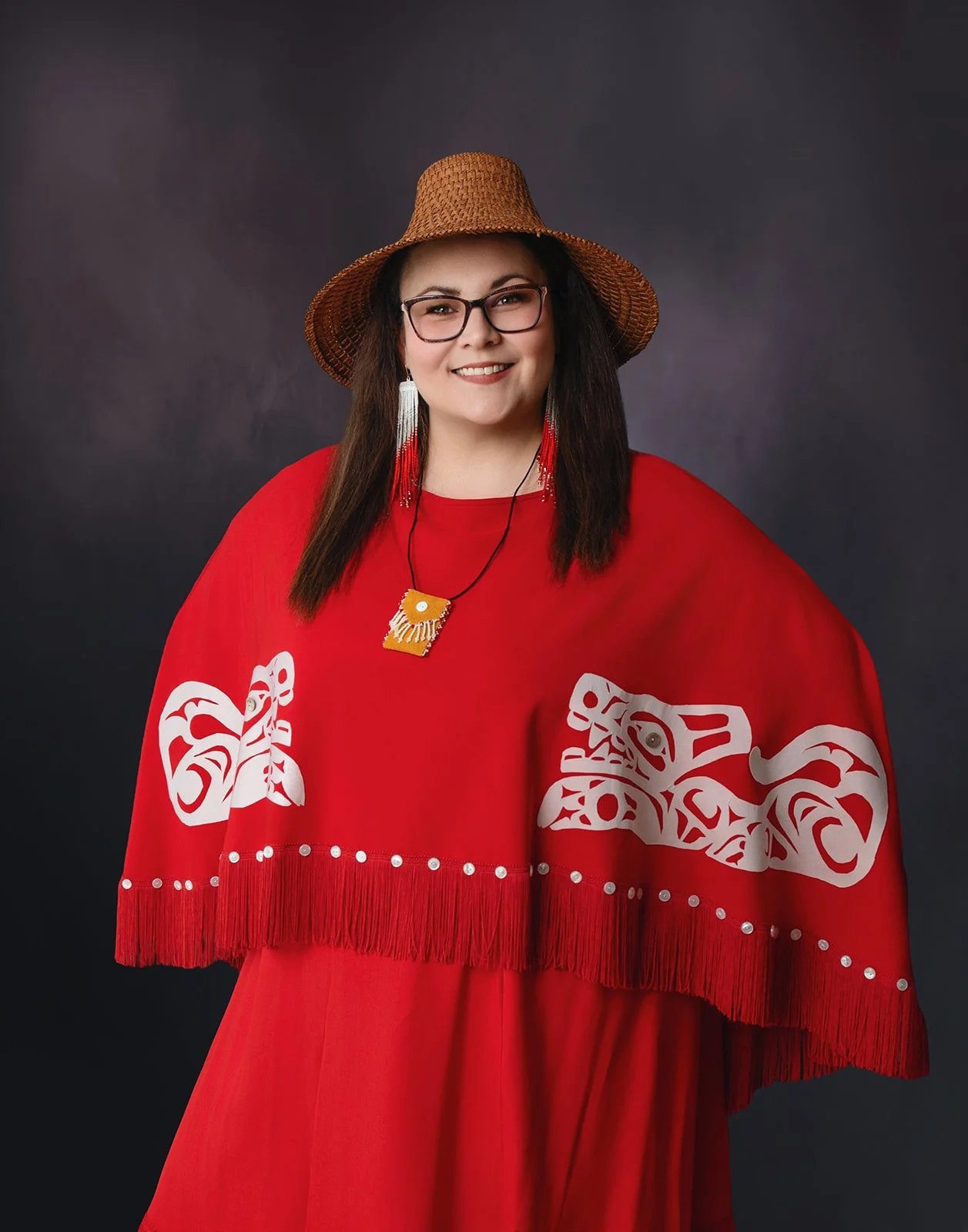
Over the years, I’ve had the privilege of working across diverse areas of social work, including child protection, restorative justice, remote practice, geriatric care, perinatal substance use, and mental wellness. I am currently working full time as a child and youth mental health therapist for a local Indigenous agency, I am on the Board of Directors for the BC College of Social Work, and own and operate Davis Nation Collective.
My practice is grounded in advocating for Indigenous rights, intergenerational healing, and decolonizing human services. As an Indigenous social worker, I recognize the unique challenges faced by our communities, especially when serving clients who share similar lived experiences shaped by colonization, trauma, and systemic barriers. This requires not only clinical skill but also self-awareness and continuous reflection.
Through my career l have gained experience in collaborative practice, chairing and facilitating meetings, governance, policy development and review, program development, resource development, advocacy, administrative tasks, delivering workshops and presentations, conflict resolution, staff onboarding and retention, and incorporating Indigenous worldviews into practice as a primary modality.
Everything I do is rooted in culture, connection, and a commitment to supporting meaningful, Indigenous-led change. I am honoured to share space with you. I am glad you are here.
Welcome.
My Approach
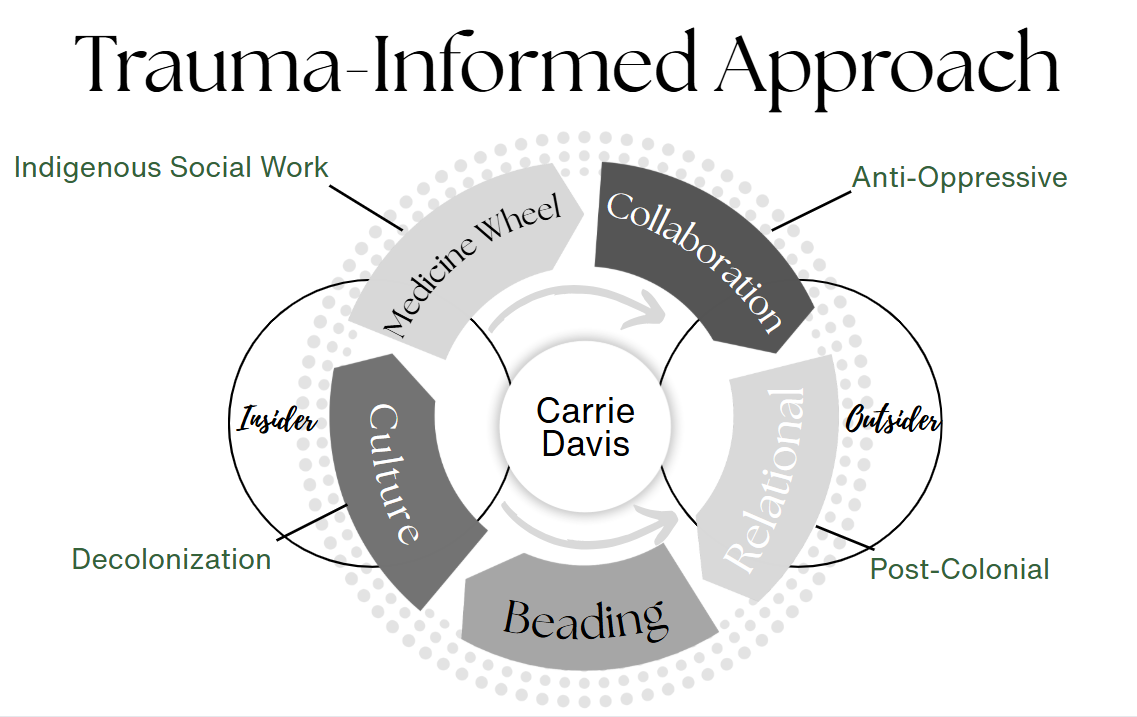
Trauma-Informed
Trauma-informed practice, for me, is a protective approach that recognizes the historical and ongoing impacts of colonization on Indigenous peoples. It focuses on safety, choice, respect, and connection, ensuring clients are never re-exposed to harm through services meant to support them. By grounding practice in culture, relational accountability, and an understanding of systemic trauma, we create new pathways for healing, new approaches that honour Indigenous identity, uphold dignity, and resist further traumatization. This way, Indigenous social work becomes not just a service, but a culturally safe space for strength, resilience, and reconciliation.
Inclusive
An inclusive approach that does not discredit non-Indigenous perspectives; instead, it recognizes that people from all backgrounds, including LGBTQIA+, BIPOC, and non-Indigenous allies, can contribute meaningfully when they engage with humility, respect, and a commitment to reconciliation. This teaching helps us see the strengths in multiple worldviews while also naming and dismantling the impacts of white supremacy, religion, and patriarchy within systems. Through authentic relationships, shared learning, and accountability, inclusivity creates space where diverse voices can walk together in a way that uplifts Indigenous knowledge without marginalizing others, while building pathways for equity and collective healing.
Two-Eyed Seeing
I approach Two-Eyed Seeing by honouring the strengths of both Indigenous and Western ways of knowing, allowing each to guide where it is most helpful. I ground my work in Indigenous worldview, culture, and relational teachings, while carefully bringing in Western tools and practices in ways that are culturally safe and supportive. For me, Two-Eyed Seeing is about balance, respect, and humility while walking with both knowledge systems to create meaningful, decolonized change for individuals, families, and communities.
Decolonization
My graduate studies focused on decolonizing policies and practices. Over the last two years, I have participated in committee building, collaborative practice, project planning, and project implementation.
Area’s of Specialty
Indigenous Justice
I have over 7 years of experience supporting Indigenous families who are navigating many challenging systems like the child welfare, legal, education, and medical system.
Health and Wellness
My entire career has been rooted in sectors of health and wellness supporting families of Indigenous and non-Indigenous backgrounds utilizing interdisciplinary approaches for wrap around support.
Get in Touch!
Click
Carrie Davis, MSW, RSW
Cell: 250-552-9929
Email: davisnationcollective@outlook.com